











Introduction
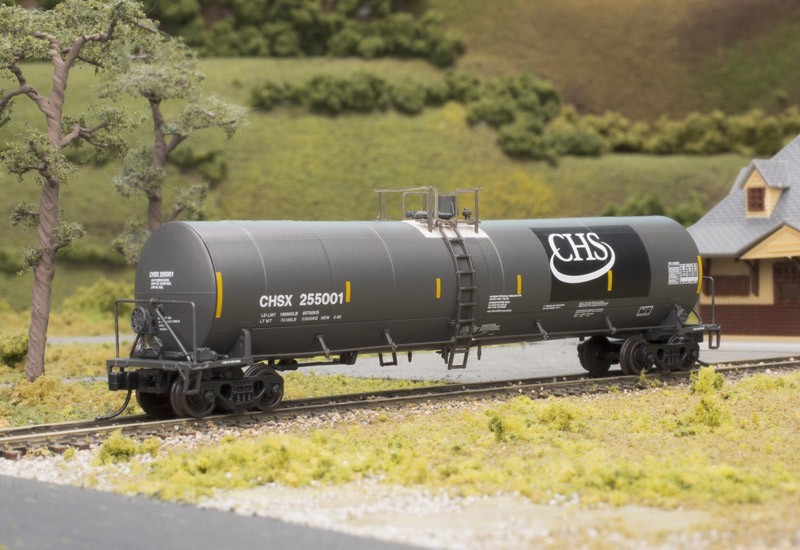
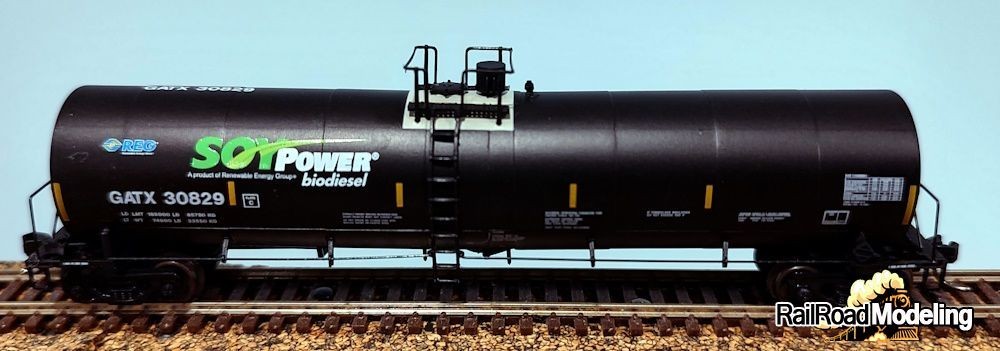
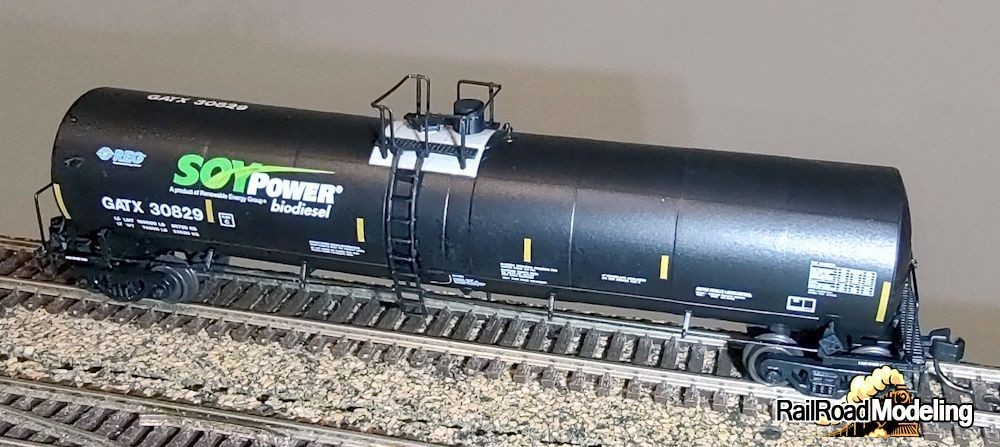
Atlas Model Railroad Company, Inc. offers this Atlas N Trinity 25,500 Gallon Tank Car. Part of Atlas' Master Line, it has been released eight times since it debuted in May, 2009, in more than two dozen road names. This review looks at the tank car decorated as GATX (Soy Power Bio Fuels) 30829, item 50 006 181. Atlas writes of this model:
Atlas’ model is of the Trinity 25,500 gal, insulated, general-purpose design. This was introduced in 1986 and production continues today. There are at least 13,000 presently in service. Typical commodities include vegetable oil, tallow, styrene, benzene, asphalt, biodiesel, acrylates, and numerous other chemicals.
TrinityRail's website states that this tank car features optional configurations to meet a customer's requirements. Join the car inspector for this walk-around.
TrinityRail
TrinityRail, the railroad part of Trinity Industries of Dallas, builds the prototype for Atlas' Trinity 25,500 gallon tank car (TrinityRail lists it as the 25,498-gallon tank car). Trinity Industries started in 1933 as Trinity Steel, which built tanks and containers for the oil industry. In the mid-1960s they began building freight cars. This must have worked well for them as in the 1980s they began gobbling up other rail car companies. They now have the rights and designs to Thrall, Greenville, and Pullman-Standard, and others, and are considered the largest freightcar builder in North America. Trinity offers over 250 freight cars types and variants:
- autoracks
- flat cars
- gondolas
- hoppers
- intermodal container cars
- steel coil cars
- tank cars.
If you are interested in technical information about this car:
AAR Class: T: Tank Car. Tank car means any car which is used only for the transportation of liquids, liquefied gases, compressed gases, or solids that are liquefied prior to unloading. Car may be without underframe if container serving as superstructure is designed to serve as underframe. If car has underframe, it must be designed only for the carriage of one or more enclosed containers (with or without compartments) that form the superstructure and are integral parts of the car.
AAR Type: T107
Detail Info: Tank Cars, General Service Cars, Carbon Steel Tank (Welded or Riveted), Includes Rubber Lined.
AAR 203, 203W, 211A60W1, 211A100W1, 211J100W1.
ICC or DOT 103, 103W, 104W, 111A60W1, 111A100W1, 111A100W3, 111A100W4
Capacity: 25,000-27,000 gal
Plate: C
Max Gross Weight: 263000
Load Limit: 189000
Liquid Capacity: 25570
Ext L/W/H: 59' 4" / 10' 5" / 14' 11"
User Notes: Load Limit: 189000
If you would like to immerse yourself in the details of tank cars, click here to access the 2022 AAR field guide to tank cars. It will teach you about Tank Car Classification & Specifications, terminology (I just learned that the end of the tank is called a "head" or "head closure"), and show you how to decode all of the stenciling on a tank car.
Click here to see a photograph of the dingy and snowy real GATX 30829.
This release of 25,000-gallon Trinity tank cars features new paint schemes.
1. Undecorated #3
2. Undecorated #5 (1994 GATX)
3. Undecorated #7
4. Undecorated #9
5. TILX (2019 Repaint)
6. TILX (IOI Group)
7. GATX (Owensboro Grain)
8. TILX (AGP)
9. GATX (Soy Power Bio Fuels)
10. NATX (UTCK repaint)
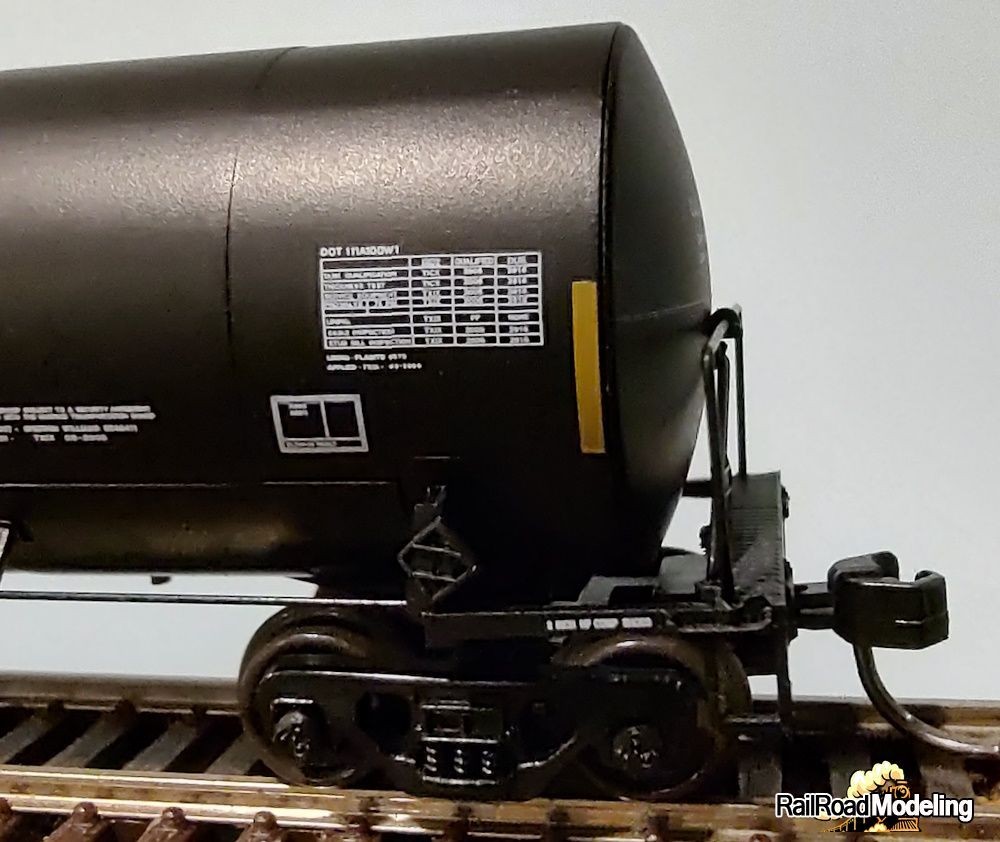
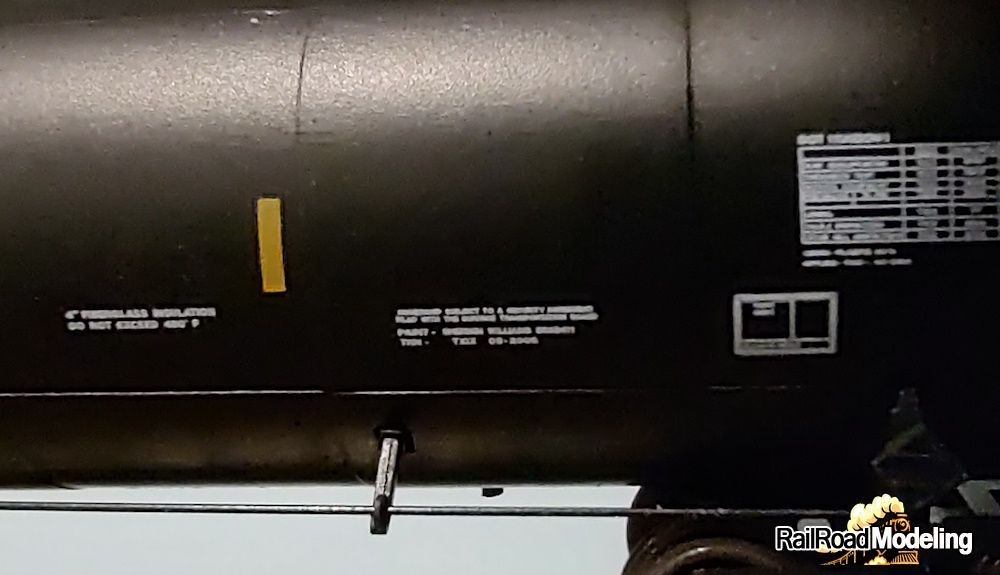
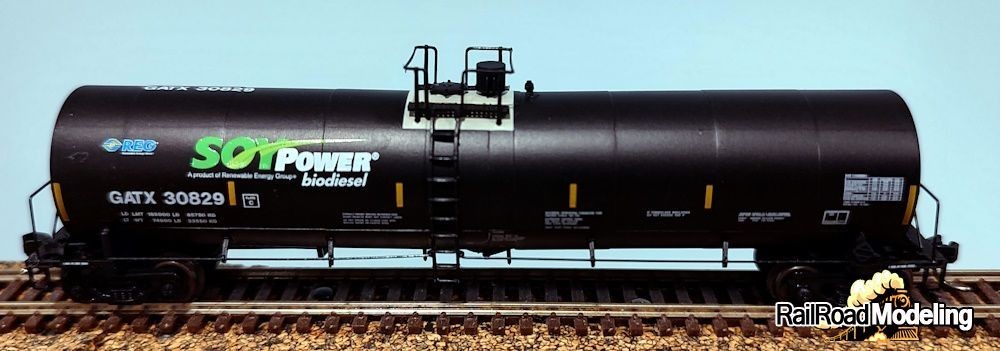
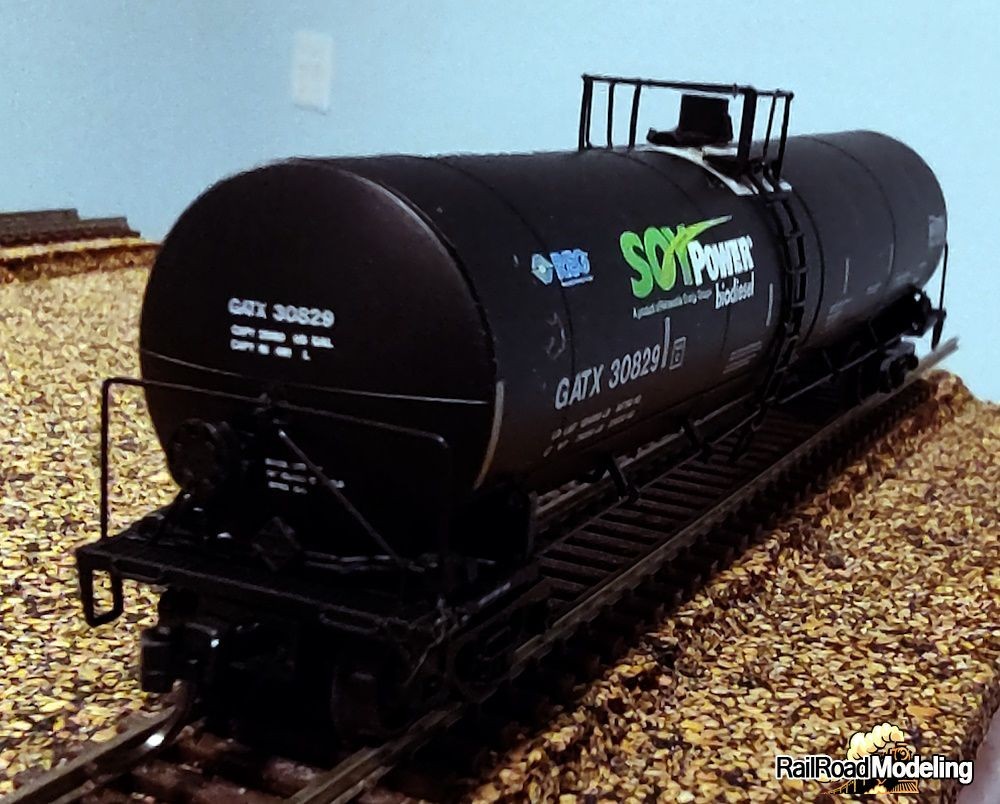
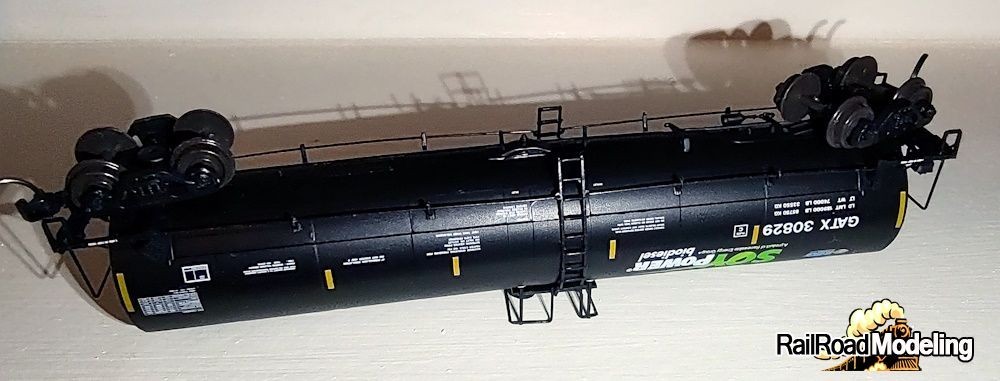
Trinity's basic black is punctuated with splashes of color of the high-visibility yellow bars along each side, the REG Marketing & Logistics Group, LLC blue logo, and the big green Soy Powered logo. Plenty of informational stenciling, too, including 2 Inch HF Comp Shoes, Consolidated Stencil, and more than that. HAZMAT placards are not used but the brackets are present.
Walkaround
Atlas' Trinity 25,500 gallon tank car features:
- Accurate painting and printing
- Numerous detail fittings and components specific to prototype
- Highly detailed body with prototypical jacket seams
- See-through walkway and top platform grating
Starting at the rails, the model rides on plastic wheels in plastic standard trucks. These feature good detail for the scale. They are mounted to body bolsters which support the tank. This design is known as a stub sill tank car and the draft gear is mounted to the sills, under the walkway. Handrails, hand brake gear on the B-end, and Hazmat placard holders are mounted on the sills.
Moving up to the tank you can see that this model is molded with 10 sections - eight of the same size, and two narrower segments under the crashbox (top platform grating). While the lap welds are difficult to see in photos of real tank cars, those segments appear authentic for actual Trinity 25,500 cars.
The layers of protection is obvious
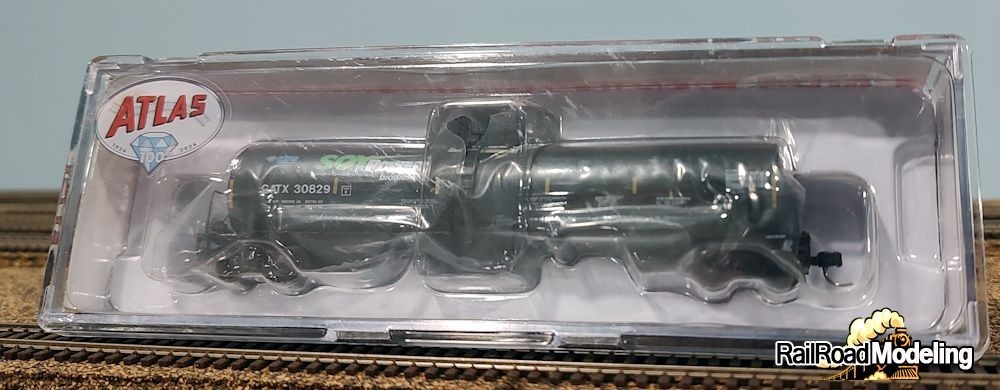
Stackable jewel case
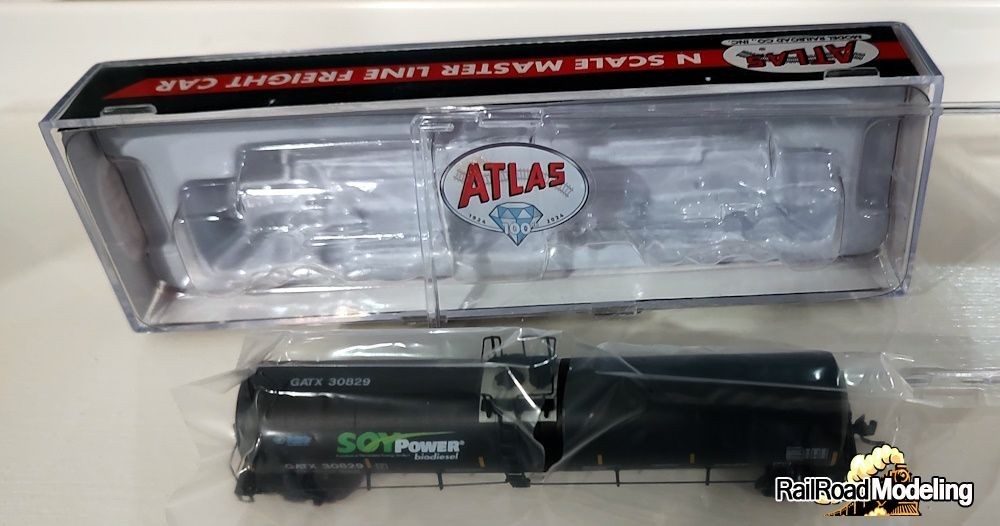
Common viewing angle
Tank Car Classification & Specifications tables
Wire details
Crashbox

Sharp crisp opaque printing
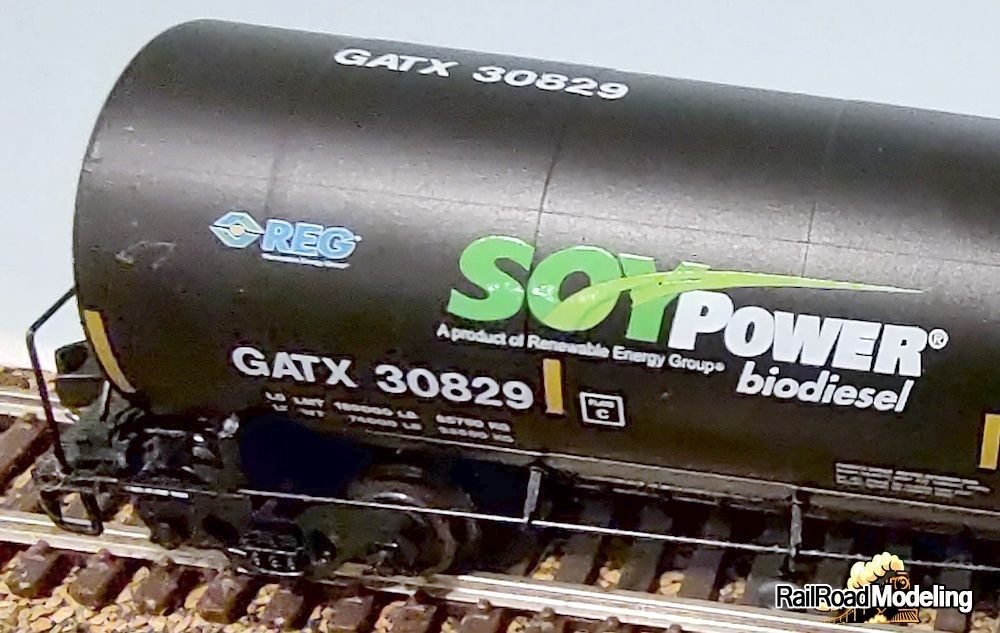
Profile
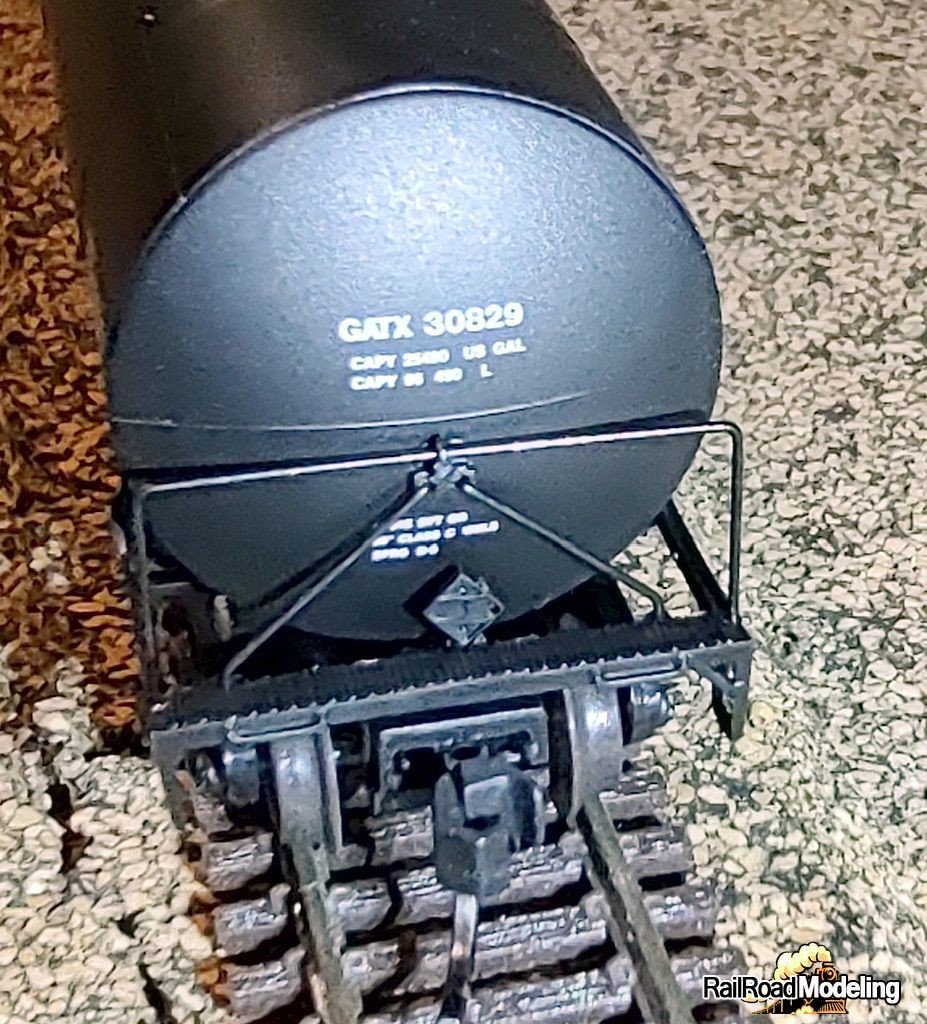
Head closure
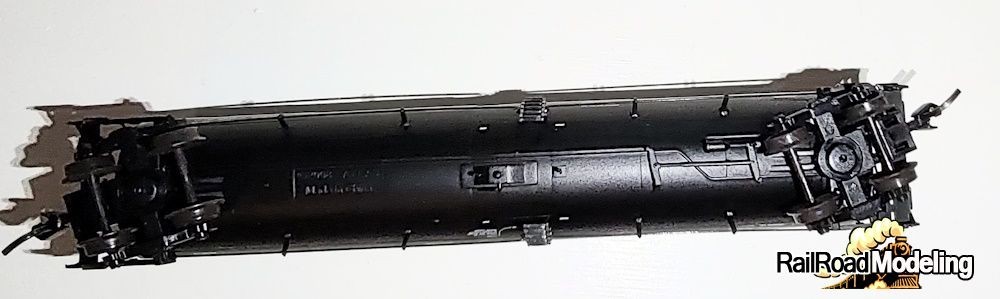
Brake gear and train line
Shadows reveal open detailing
Performance
My sample rolled smoothly over code 80 turnouts both through and towards the points. To assess how the car alone would perform without stabilization from other cars or the "0-5-0 finger switcher" I gently tipped the layout to let gravity power the solo car along its route. Smooth and stable.
Coupling it to other N cars I deem the couple height is in specifications. I weighted it at 1.1 ounces which aligns with NMRA standards.
Conclusion
Modelers of N scale subjects of the late 1980s until today should consider filling their roster with this good looking Atlas Master Line modern tank car. It performs without trouble, looks sharp and accurate, sporting detail on available in larger scales until a decade or so ago. Atlas' paint and printing leaves nothing to be desired. Happily recommended.
Please remember to mention to Atlas and retailers that you saw this model here - on RailRoad Modeling.